

Undocumented Immigrants Pay Lots of Taxes and Shore Up Our Social Security Fund
Immigration has always shaped the United States, and debates about immigration policy remain as important as ever today.

Immigration has always shaped the United States, and debates about immigration policy remain as important as ever today.
A 2024 study from the Institute on Taxation and Economic Policy found that undocumented immigrants paid $96.7 billion in federal, state, and local taxes in 2022 — even though many are legally barred from using the programs those taxes fund. This directly challenges the claim that undocumented immigrants are draining or “destroying” public programs.
Most of what they pay comes out of their paychecks — through income taxes and payroll taxes. Those payroll taxes help fund major programs like Social Security, Medicare, and Unemployment Insurance. The bottom line: undocumented workers are helping keep these programs financially afloat, despite being ineligible to collect most of the benefits those programs provide.
Fact Sheet: The Economic Impact of Undocumented Immigrants
- They are Major Taxpayers
- Undocumented immigrants contribute $96.7 billion in federal, state, and local taxes annually.
- Even without a Social Security number, millions use ITINs to file tax returns, contributing to the public funds that build our roads and schools.
- They Subsidize Social Security
- Undocumented workers pay roughly $13 billion into the Social Security Trust Fund every year, and they cannot ever claim these benefits, effectively providing a multi-billion-dollar “gift” to the system’s solvency for U.S. retirees.
- They Secure the Food Supply
- Roughly 50% of all hired farmworkers in the U.S. are undocumented.
- Without this workforce, domestic food production would plummet, and grocery prices would skyrocket.
- They Drive the GDP
- Research suggests that mass deportation would result in a $4.7 trillion loss to the U.S. GDP over the next decade.
- This population doesn’t just work; they are consumers who drive demand in housing, retail, and local services.
- They Fill “Essential” Roles
- A disproportionate number of undocumented immigrants work in construction, elder care, and hospitality industries, which are currently facing severe labor shortages that many native-born workers avoid.
Further, the study, looking at 2022 data found that undocumented immigrants paid $96.7 billion in taxes that year. The researchers also estimated that if all undocumented immigrants were granted the legal right to work, tax revenue from this group would increase by an additional $40 billion per year. The reason? Legal work status leads to better-paying jobs, and workers with better-paying jobs are also more likely to fully comply with tax laws — both of which mean more taxes collected.
The Study:
According to that study, undocumented immigrants contribute to the American economy in the following ways:
Undocumented immigrants contribute nearly $97 billion in taxes each year. In 2022, they paid $96.7 billion in federal, state, and local taxes — about $59 billion to the federal government and $37 billion to state and local governments.
That breaks down to roughly $8,900 per person. For every million undocumented immigrants living in the U.S., governments collect about $8.9 billion in tax revenue.
A large chunk of what they pay funds programs they can’t use. Over a third of their tax dollars go to payroll taxes like Social Security ($25.7 billion), Medicare ($6.4 billion), and unemployment insurance ($1.8 billion) — programs that undocumented immigrants are legally prohibited from collecting benefits from.
At the state and local level, most of their taxes come from everyday spending. About 46% comes from sales taxes on purchases, 31% from property taxes (whether they own or rent), and 21% from income taxes.
Six states each collect over $1 billion from undocumented immigrants: California ($8.5B), Texas ($4.9B), New York ($3.1B), Florida ($1.8B), Illinois ($1.5B), and New Jersey ($1.3B).
In 40 states, undocumented immigrants pay a higher tax rate than the wealthiest 1% of residents.
Undocumented immigrants also face an uneven playing field at tax time. Many are blocked from claiming tax credits available to citizens, and some don’t claim refunds they’re actually owed — often out of fear or lack of access to tax help.
Granting work authorization could add $40 billion more in annual tax revenue. With legal work status, their total contributions would rise from $96.7 billion to $136.9 billion per year — $33 billion more for the federal government and $7 billion more for states and localities.
Effect of Work Authorization on Undocumented Immigrant Taxes
Undocumented immigrants pay less in taxes than they would if they had legal work status. That’s not because they avoid taxes — it’s because working without authorization limits their opportunities and earnings.
Giving them work authorization would boost tax revenue in two ways:
- They’d be more likely to fully comply with tax laws, bringing in more income tax revenue.
- Legal workers tend to earn higher wages. Better job access and education opportunities would mean higher paychecks — and higher paychecks mean more taxes paid on income, spending, and property.
The numbers are significant. Experts estimate that giving the current undocumented population the right to work legally would increase their total tax contributions by about $40 billion per year — jumping from roughly $96.7 billion to $136.9 billion annually. Of that increase, about $33 billion would go to the federal government, and around $7 billion would go to state and local governments.
In short, legal work status doesn’t just benefit immigrants — it puts substantially more money into public coffers at every level of government.
Change in Tax Contributions by the Currently Undocumented Population if Legal Status is Granted
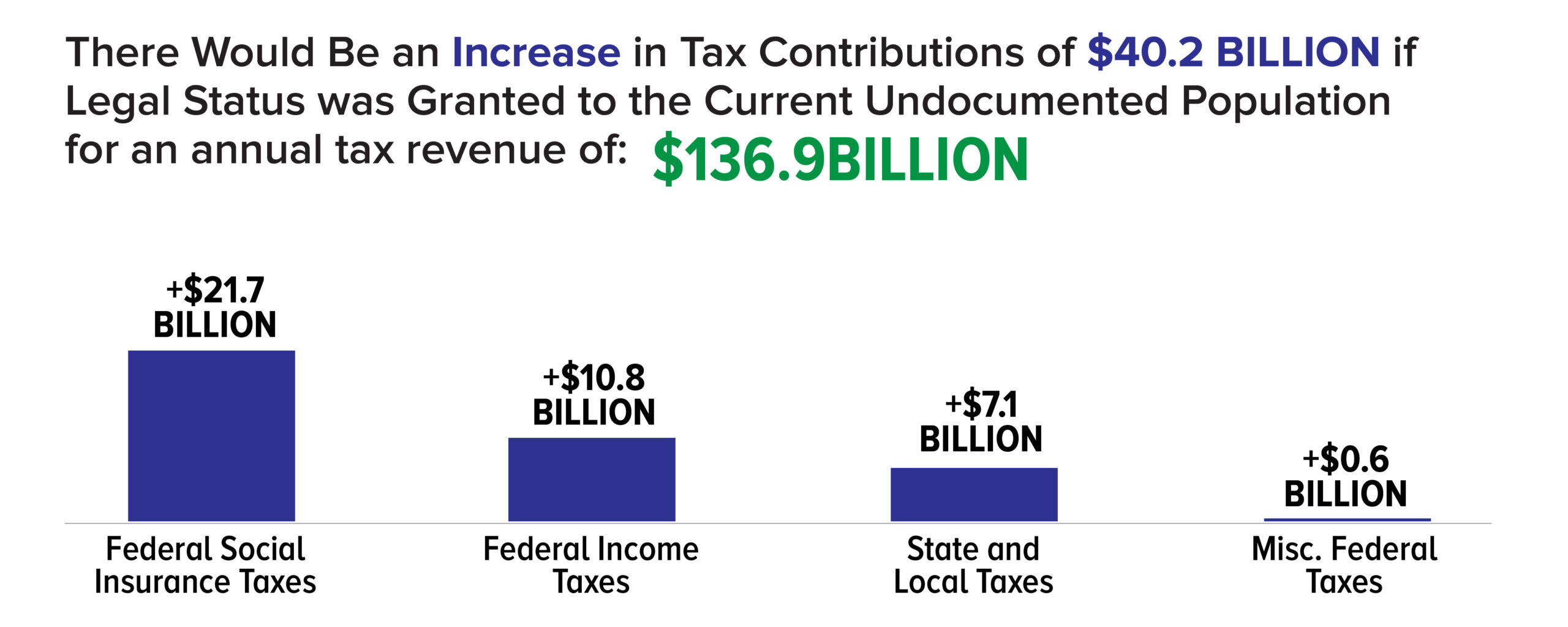
Note: The change in federal social insurance tax revenue includes both the employer and employee shares of levies that fund Social Security (+$17.3B), Medicare (+$4.4B), and the federal portion of Unemployment Insurance (+$0.1B). Source: Institute on Taxation and Economic Policy
Other Taxes Undocumented Immigrants Pay
More people generally means a stronger economy. Undocumented immigrants aren’t just workers — they’re also shoppers. They spend money at local businesses, rent and buy homes, and these activities create jobs for American citizens in stores and restaurants.
They pay taxes too. Like everyone else, undocumented immigrants pay sales tax when they buy groceries, gas, or household goods. They pay property taxes — either directly if they own a home, or built into their rent if they don’t. Many also have income and payroll taxes taken out of their paychecks automatically, or they file taxes using a special ID number issued by the IRS.
Removing undocumented immigrants would cost the economy enormously. The total value of everything the U.S. produces — called GDP — would take a major hit if undocumented workers were deported. Some estimates put that loss at around $4.7 trillion over ten years, simply because millions of productive workers would no longer be contributing to the economy.
Who are The Undocumented Immigrants in America?
Diverse. Most undocumented immigrants come from the Americas, but nearly a quarter come from Asia, Africa, Europe, and the Pacific Islands. Just over 4 in 10 are from Mexico.
Families. Close to half of undocumented immigrant adults are married. Compared to U.S. citizens, undocumented immigrants are more likely to be raising children.
Mixed Status. Most undocumented immigrants live in families where some members have legal status, and others don’t. In total, 12 million U.S. citizens — including 6 million children — live in these mixed-status households.
Working. Almost all of the money undocumented immigrants earn comes from jobs — 86% from wages and 11% from self-employment. They actually participate in the workforce at a higher rate than people born in the U.S., making up 4.7% of all workers, even though they’re only 3.4% of the total population.
Established. Most undocumented immigrant adults have lived in the United States for 16 years or more.
Concentrated. Although undocumented immigrants are more spread out across the country than they used to be, more than half still live in just four states: California, Texas, Florida, and New York.
Conclusion:
Undocumented immigrants contribute significantly to paying for public roads, schools, and services. In 2022 alone, they paid $96.7 billion in taxes across federal, state, and local governments.
More than a third of that — about $33.9 billion — went toward social programs like Social Security and Medicare that they are not allowed to use because of their immigration status.
In total, $59.4 billion went to the federal government, and $37.3 billion went to state and local governments. These numbers make it clear that immigration policy decisions have a real and significant impact on how much money governments collect at every level.
The economic role of undocumented immigrants goes beyond just tax dollars. They help keep key industries like farming and construction running, and they breathe new life into local communities. In many ways, they function as a quiet but powerful driver of American economic growth.
This matters especially now. As the U.S. population ages and birth rates among American-born citizens decline, the work and economic participation of immigrants — regardless of legal status — will play a critical role in keeping the country prosperous for years to come.

The Economic and Social Consequences of Mass Deportation
Mass deportation is often framed as a solution to immigration challenges, but the reality is far more complex. When large-scale deportations occur, they do not just affect those being removed—they send shockwaves through families, communities, and the nation as a whole.

The Consequences of Mass Deportation on the Workforce
Deportation is not just a policy decision; it is a human issue. Behind every statistic is a story, a family, a community that will feel the weight of that decision for generations. As a nation built on immigration, the United States must choose a path that reflects its values of compassion, opportunity, and justice.

Honduran immigrants are in danger and it’s partly our fault
Put yourself in the shoes of a Honduran Immigrant who has been here for 20 years. Would you voluntarily return to the still-troubled country you left two decades ago when you have been striving to live the American Dream? This isn’t who we are. We are a nation of immigrants, and it’s in our interest that we keep that dream alive for future generations.